






 Trap
 Continuous
There Can Be Only One
View:
12819
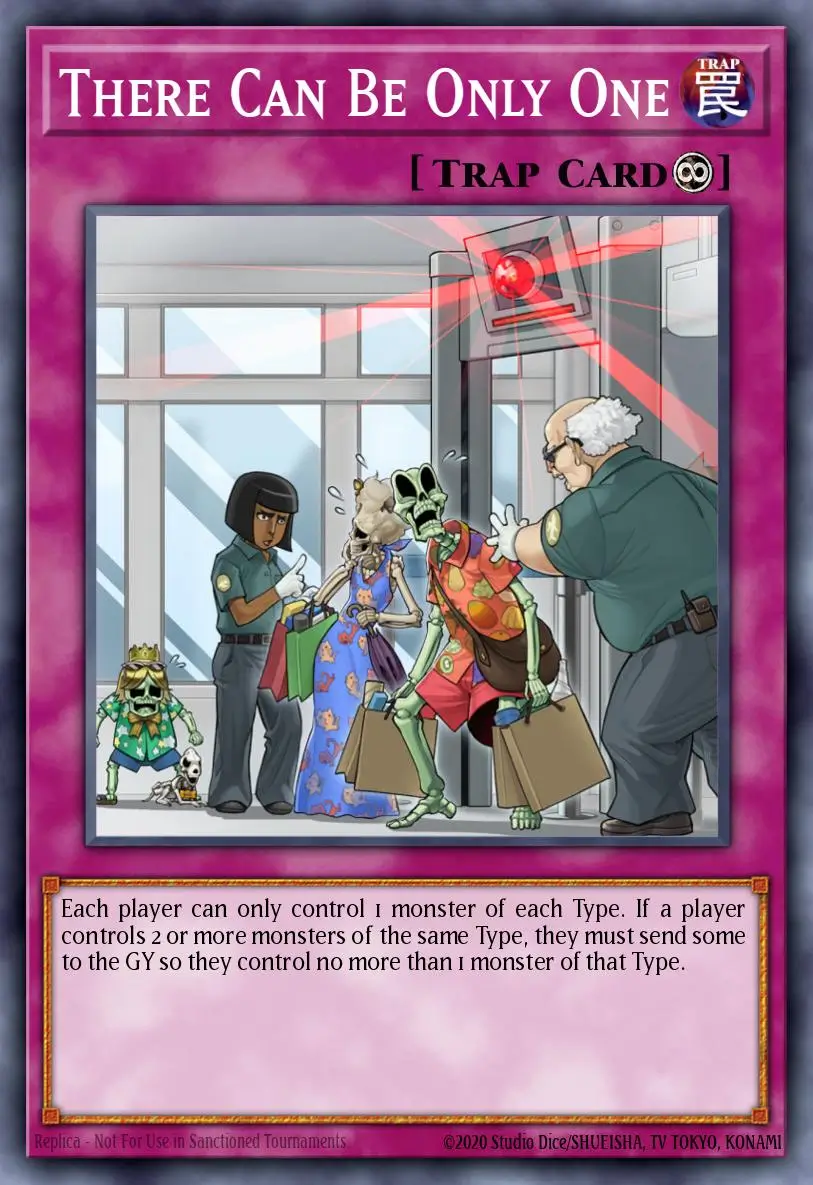
Each player can only control 1 monster of each Type. If a player controls 2 or more monsters of the same Type, they must send some to the GY so they control no more than 1 monster of that Type.


There Can Be Only One — Power Evaluation
Final Score: 60 ± 8 · Confidence: Medium
- Intrinsic: 58 · Deck: 62 · Meta: provisional
- Primary role: Floodgate/Control · Secondary: Board breaker
Why it scores here
There Can Be Only One is a continuous floodgate: it only does something once a player controls two or more monsters of the same Type, and then forces the excess to the GY. Its power comes from restricting boards that stack a Type, not from its own body, which does not exist because it is a trap. The 400-deck sample and 111 archetypes show it is a broadly accepted staple, but that frequency confirms portability, not strength. High card stats do not apply here, and the card earns no points for raw presence.
Axis scores
| Axis | Score | Evidence |
|---|---|---|
| Accessibility | 50 | Set trap with no searcher or starter route in the text, and no combo starter/searched data to confirm live access; it is accessible through draw and the staple lists (observed/inferred). |
| Combo & Conversion | 15 | Zero recorded combo boards and no conversion into a board; it does nothing on its own (verified: combo data total combos 0). |
| Resource Economy | 30 | Makes the opponent send monsters to the GY but gives the controller no card advantage or refuel (verified text). |
| Effect & Interaction | 60 | Strong conditional floodgate against Type-stacked boards that is hard to play around by design, but dead against a board with unique Types (verified text, inferred strength). |
| Material Utility | 10 | Trap card with no Level, Attribute, or material body, so it contributes nothing as material (verified: card frame trap). |
| Resilience & Flexibility | 55 | Persists as a continuous card across turns, but it is a backrow card that can be destroyed, and no redundancy exists in the text (inferred). |
| Deck-Building Efficiency | 75 | Single-copy slot in 395 of 400 decks with no garnet or lock cost; it is cheap to run but only pays off in specific boards (observed/verified). |
Calculation
Weight profile: Floodgate/Control primary only; no secondary blend applied. Intrinsic ≈ 58, Deck ≈ 62, Meta = provisional. Modifiers: none. Final formula: 0.40*Intrinsic + 0.60*Deck
Strengths
- Floodgate that punishes Type-stacked boards, which is common across many archetypes
- Single-copy, low-cost slot that fits 111 distinct archetypes
- Consistently included in its top partner decks (Ash Blossom, S:P Little Knight, Mulcharmy)
Weaknesses
- Zero combo evidence, so conversion power rests on text alone
- Dead against boards with no duplicate Types
- Backrow card that can be removed or ignored
Counters / choke points
- Backrow removal or destruction effects
- Decks that avoid stacking monsters of the same Type
Best use
Floodgate / Type-stack disruption. Decks: K9, Vanquish Soul, Sky Striker, Eldlich, Regenesis. Suggested copies: 1.
Evidence & gaps
- Verified: Continuous trap: restricts a player to 1 monster per Type and sends the excess to the GY (card text); Single copy in 395 of 400 sample decks (deck data); No recorded combo boards (combo data)
- Observed: Inclusion 60-100% across 5 StatisticsCard archetypes (usage statistics); Top partners include Ash Blossom and S:P Little Knight (deck data); Guides name it as a floodgate staple in Clear World and Subterror (guide data)
- Inferred: Strength depends on opponent Type stacking, so it is situational; Backrow vulnerability lowers resilience
- Data gaps: no combos supplied — combo conversion is text-only inference 400/400 sample decks run it, so the sample may be selected on the card and not a global play-rate measure no rulings or banlist data supplied no Rush Duel or format-specific placement data beyond the top-card context